Artificial Grass Drainage and Base Prep for Peel Region Soil in Caledon
Artificial grass drainage and base prep make or break an installation, and in Peel Region the soil gives you plenty to plan for. Caledon spans two very different landscapes: the sandy, gravelly Oak Ridges Moraine that drains fast, and the clay-heavy valley bottoms and subdivision fill that drain slowly and heave with frost. Get the base right for your specific lot and a synthetic lawn stays flat, firm, and dry for decades. Get it wrong and you see pooling, ripples, and weed growth within a couple of seasons. This guide explains how Artificial Grass Caledon preps a base for Caledon and Peel Region conditions.
How does artificial grass drain?
Quality artificial grass drains vertically. The turf backing is perforated, so rain and meltwater pass straight down through the surface into a compacted stone base and then into the native soil or a drainage outlet below. That is the opposite of a hard patio, where water has to run off to the sides. For vertical drainage to work, the layer under the turf has to be a free-draining, well-compacted aggregate, not the original topsoil or clay. Skimp on that layer and the whole system backs up.
What base does Peel Region soil need?
It depends where in Caledon you are. Two broad situations cover most properties.
Sandy and gravelly moraine soil
Much of the higher ground across Caledon sits on the Oak Ridges Moraine, where the native soil is sandy loam and gravel that already drains well. On these lots a standard base of 3 to 4 inches of compacted crushed stone (granular A) over a geotextile separation fabric is usually plenty. The fabric stops the stone from mixing into the soil below and blocks weeds from pushing up.
Clay soil and subdivision fill
Down in the valley areas and across the newer subdivisions of Mayfield West, Southfields, and parts of Bolton, the ground is often compacted clay or imported fill that holds water. These lots need more work: a deeper stone base, typically 4 to 6 inches, and in low spots a perforated pipe or French drain routed to daylight or a catch basin so water is not trapped between the clay and the turf. Skipping that step on a clay lot is the single most common cause of a spongy, puddling turf lawn in this area.
Why does frost heave matter in Caledon?
Caledon sits higher and colder than most of the GTA, so the ground goes through more freeze-thaw cycles each winter. When water trapped in a poorly drained base freezes, it expands and lifts the surface, then drops it again on the thaw. Over a few winters that movement creates ripples and uneven spots. A properly drained, well-compacted granular base gives the water somewhere to go before it freezes, which is why drainage and frost protection are really the same job here. Compaction is key: we compact the sub-base in layers so it does not settle unevenly later.
What about shallow rock near the escarpment?
Some properties near the Niagara Escarpment and the Forks of the Credit area hit limestone or shale close to the surface. You cannot dig a deep base into rock, so the approach shifts to building up a stable, free-draining layer above it and grading a gentle slope so water sheds toward a lower edge or drain. It is very workable, it just needs to be assessed on site rather than assumed from a plan.
The base-prep steps we follow
- Excavate the existing lawn or surface to the depth the soil type requires.
- Lay a geotextile fabric to separate stone from soil and block weeds.
- Add and compact crushed stone in layers, 3 to 4 inches on sandy soil, 4 to 6 inches on clay.
- Set a slight grade toward a drain or lower edge, and add a French drain on wet clay lots.
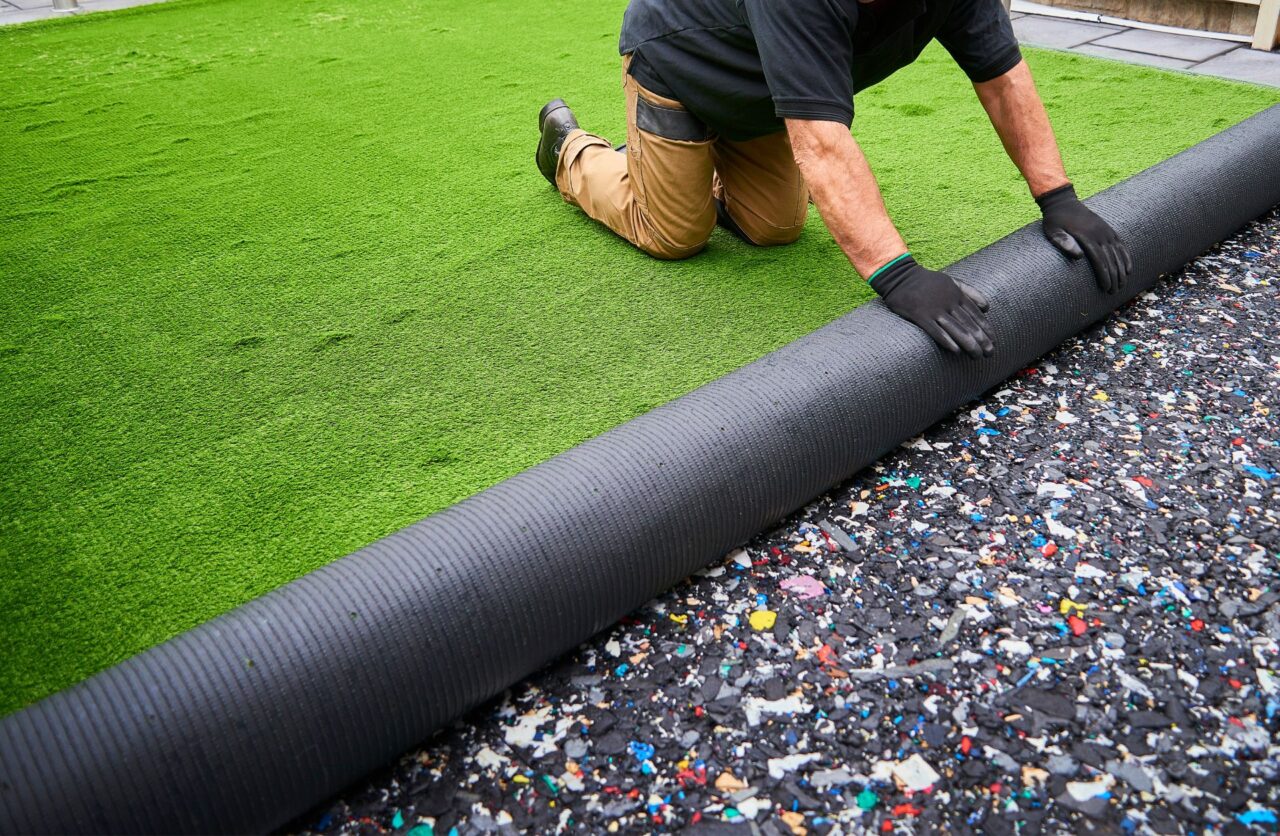
- Screed a fine top layer smooth, then lay, seam, and secure the turf with infill for ballast and drainage.
Done right, the same base that keeps a backyard lawn flat also supports a putting green or a pool surround on the same property. The details change with the soil, but the principle holds everywhere in Caledon: build the base for the water first, and the turf on top lasts.
Can you install artificial grass over an existing surface?
Sometimes, yes. Turf can be laid over a sound concrete patio, interlock, or a compacted gravel pad as long as water can still escape. On concrete we confirm the slab is graded to drain and use a permeable turf backing so rain and meltwater run to the existing edge or drain rather than sitting underneath. What does not work is laying turf straight onto an old natural lawn or bare clay without building a proper base first, because the soft, water-holding ground below will settle unevenly and trap moisture. When a homeowner in Bolton or Caledon East asks about saving money by skipping excavation, this is the honest answer: on a hard, well-draining surface it can be done, but over soil the base is not optional.
Frequently Asked Questions
Does clay soil cause problems for artificial grass in Caledon?
Clay holds water, so it needs more base preparation than sandy moraine soil. On clay lots in areas like Mayfield West and Southfields we build a deeper crushed-stone base and often add a French drain, which prevents the pooling and sponginess that a thin base would cause.
How deep should the base be under artificial grass?
On free-draining sandy or gravelly Caledon soil, 3 to 4 inches of compacted crushed stone is typical. On clay or compacted subdivision fill, 4 to 6 inches plus drainage is safer. The right depth is set on site based on your soil and grade.
Will artificial grass heave with frost?
Not if the base is built for it. A well-compacted, free-draining granular base lets water escape before it freezes, which prevents the lift-and-drop movement that causes ripples. Poor drainage is what leads to frost heave, so base prep is the fix.
Get a Free Drainage Assessment in Caledon
Not sure what your Caledon lot needs under the turf? Call (289) 906-7457 or reach us through the contact page for a free on-site soil and drainage assessment before you commit to a project.